Invited Review: Xu and Colleagues Systematically Dissect the Mechanisms, Regulation, and Clinical Translation of Necroptosis
Date:2026-07-21
Cell death remains a central paradigm in the life sciences. Over the past two decades, the recognition of necroptosis as a programmed form of necrosis has fundamentally reshaped our understanding—necrosis is not invariably a passive, unregulated process, but can instead be orchestrated by elaborate genetic programs. Recently, a comprehensive review entitled "Mechanisms, regulation and clinical relevance of necroptosis" was published online in NatureReviews Molecular Cell Biology by Dr. Daichao Xu and colleagues at the Interdisciplinary Research Center on Biology and Chemistry (Shanghai Institute of Organic Chemistry, Chinese Academy of Sciences). This Review synthesizes the molecular mechanisms, regulatory networks, and translational landscape of necroptosis, and notably introduces a binary classification—extrinsic versus intrinsic subtypes—based on distinct trigger-sensing and signal-integration logic. This framework provides a valuable conceptual scaffold and highlights priority areas for future inquiry.
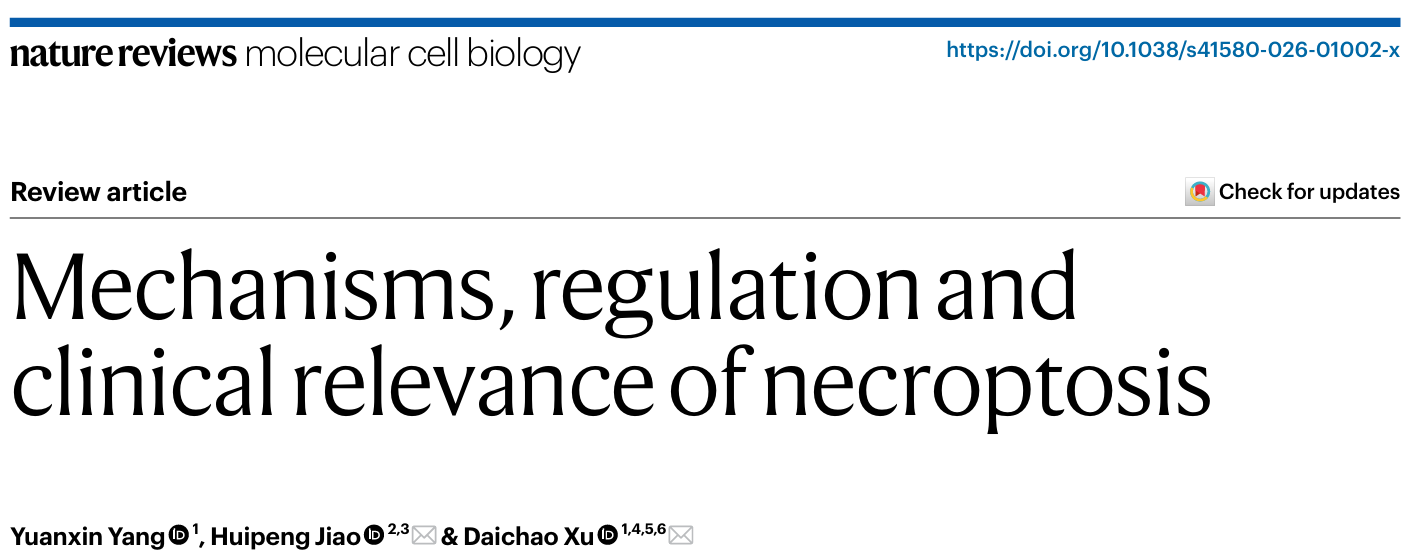
Necroptosis is a caspase‑independent, lytic, programmed cell death pathway mediated by the core effectors RIPK1, RIPK3, and MLKL. It culminates in MLKL-driven plasma‑membrane pore formation, leading to membrane rupture, release of damage‑associated molecular patterns, and robust inflammatory responses. Although this pathway serves essential physiological functions in antiviral defense, tissue repair, and immune homeostasis, its excessive or aberrant activation is tightly linked to a broad spectrum of human diseases, including Alzheimer's disease, amyotrophic lateral sclerosis, multiple sclerosis, inflammatory bowel disease, and metabolic dysfunction‑associated steatohepatitis.
The Review proposes a dichotomous classification framework. Extrinsic necroptosis is triggered by membrane‑bound receptors—such as TNFR1, TLR3, and TLR4—at the plasma membrane or endosomes, via receptor clustering and assembly of downstream signaling complexes. In contrast, intrinsic necroptosis is initiated intracellularly by the cytosolic sensor ZBP1 upon detection of left‑handed Z‑nucleic acids (Z‑RNA or Z‑DNA). This classification directly parallels the classic extrinsic/intrinsic apoptosis pathways, offering a unifying lens for understanding how diverse stimuli converge on the common RIPK3–MLKL execution machinery.
Mechanistically, the Review dissects the hierarchical regulatory networks governing necroptotic signaling. RIPK1 functions as a critical molecular switch, whose activity is tightly controlled by post‑translational modifications—including ubiquitination, phosphorylation, palmitoylation, and methylation—as well as by caspase‑8‑mediated proteolytic cleavage. Activation of RIPK3 and MLKL is primarily driven by site‑specific phosphorylation. Moreover, the Review systematically examines ZBP1‑mediated sensing of endogenous Z‑nucleic acids, covering how both viral‑ and host‑derived Z‑RNA/Z‑DNA activate ZBP1 to trigger cell death and inflammation, and how negative regulators such as ADAR1 maintain immune quiescence.
On the disease and therapeutic front, the Review emphasizes the critical pathogenic roles of necroptosis in degenerative, inflammatory, metabolic, and genetic disorders. Small‑molecule RIPK1 inhibitors have undergone safety assessment in multiple clinical trials, with several advancing to Phase II studies for inflammatory bowel disease, psoriasis, rheumatoid arthritis, and neurodegenerative conditions.
Despite substantial progress, the Review candidly highlights several unresolved questions: the precise architecture of MLKL pores in membranes remains elusive; the mechanism by which ZBP1 discriminates physiological from pathological Z‑nucleic acid ligands is unknown; sensitive biomarkers and imaging tools for detecting necroptosis in vivo are lacking; and the modest efficacy of first‑generation RIPK1 inhibitors in certain trials may reflect their preferential targeting of the inactive RIPK1 conformation, underscoring the urgent need for next‑generation inhibitors that engage the active conformation.
Dr. Daichao Xu (Interdisciplinary Research Center on Biology and Chemistry, Shanghai Institute of Organic Chemistry, Chinese Academy of Sciences) serves as the corresponding author, with Dr. Yuanxin Yang as the first author and Dr. Huipeng Jiao (Life Sciences Institute, Zhejiang University) as co‑corresponding author. This work was supported by the National Science Fund for Distinguished Young Scholars, the National Natural Science Foundation of China, the Shanghai Basic Research Pioneer Project, the Shanghai Municipal Science and Technology Major Project, the Chinese Academy of Sciences, and the China Postdoctoral Science Foundation.
Article Link:
https://doi.org/10.1038/s41580-026-01002-x
附件下载: