Scientists Uncover a New GLP-1 Breakdown Pathway—and Use It to Build Longer-Lasting Drugs
Date:2026-09-02
Researchers identify insulin-degrading enzyme as a regulator of GLP-1 stability and use the mechanism to engineer degradation-resistant analogs
SHANGHAI - Researchers at the Shanghai Institute of Organic Chemistry, Chinese Academy of Sciences, have uncovered a previously unrecognized pathway that controls the stability of glucagon-like peptide-1 (GLP-1), a hormone at the center of several widely used treatments for diabetes and obesity. The study identifies insulin-degrading enzyme (IDE) as an important GLP-1-degrading protease and shows how this mechanism can be exploited to design longer-lasting GLP-1 receptor agonists, including molecules with improved stability in the central nervous system.
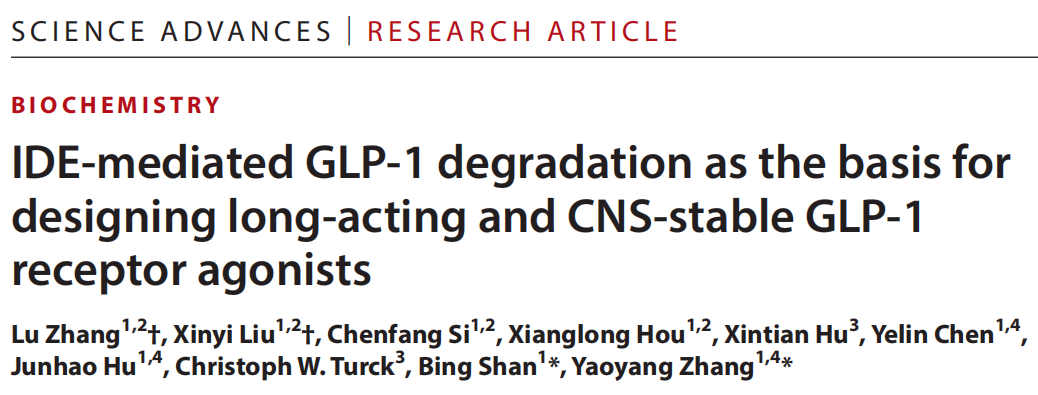
The work, led by Drs. Yaoyang Zhang and Bing Shan at the Interdisciplinary Research Center on Biology and Chemistry, was published in Science Advances under the title “IDE-Mediated GLP-1 Degradation as the Basis for Designing Long-Acting and CNS-Stable GLP-1 Receptor Agonists.”
GLP-1 is an incretin hormone that stimulates glucose-dependent insulin secretion, suppresses glucagon release, and helps regulate appetite and energy balance. Its therapeutic importance has grown rapidly with the success of GLP-1-based drugs in diabetes and obesity. Yet native GLP-1 is short-lived, in large part because it is rapidly inactivated after secretion. Dipeptidyl peptidase-4 (DPP-4) has long been regarded as a major enzyme responsible for this process, and resistance to DPP-4-mediated cleavage is a central feature of many long-acting GLP-1 therapeutics.
The new study suggests that this picture is incomplete. By combining proteomics with biochemical assays, cellular experiments, and animal models, the researchers found that IDE can also directly degrade GLP-1. Reducing IDE abundance increased GLP-1 stability and strengthened GLP-1-mediated glucose regulation, indicating that IDE is not simply associated with GLP-1 metabolism but can function as a physiologically relevant determinant of peptide stability.
Mass spectrometry provided a molecular explanation for the effect. The team mapped two IDE cleavage sites in GLP-1, revealing where the protease attacks the hormone. That information then became a design principle: rather than simply extending circulating half-life, the researchers modified GLP-1 at vulnerable cleavage positions to make the peptide intrinsically more resistant to IDE.
Using D-amino acid substitutions at key cleavage sites, the group generated GLP-1 analogs with increased resistance to IDE-mediated proteolysis. They then applied the same strategy to semaglutide and developed D-Ser18-semaglutide. Compared with semaglutide, the engineered analog showed greater stability in several biological environments, including plasma, peritoneal fluid, and cerebrospinal fluid, and produced more sustained glucose-lowering and metabolic effects in animal models.
The central nervous system findings may be particularly important. DPP-4-mediated inactivation is often discussed in the context of the circulation, whereas IDE is broadly expressed across tissues, including the brain. The study found that IDE contributes to the control of GLP-1 stability in the CNS microenvironment. Molecules engineered to resist IDE degradation remained more stable in the brain and produced more sustained effects on body-weight regulation.
These results broaden the conventional view of how GLP-1 drugs can be optimized. Current strategies have largely emphasized protection from DPP-4 cleavage and prolongation of systemic exposure. The new work adds tissue-specific proteolysis as another design variable, suggesting that the performance of GLP-1 receptor agonists may depend not only on how long they circulate, but also on how well they resist degradation after reaching distinct biological compartments.
The findings also illustrate a broader drug-development strategy: mapping endogenous peptide-degradation pathways and then engineering around them. Such an approach could help generate therapeutic peptides that are tailored for stability in particular tissues or extracellular environments, potentially improving durability of action without relying exclusively on conventional half-life extension technologies.
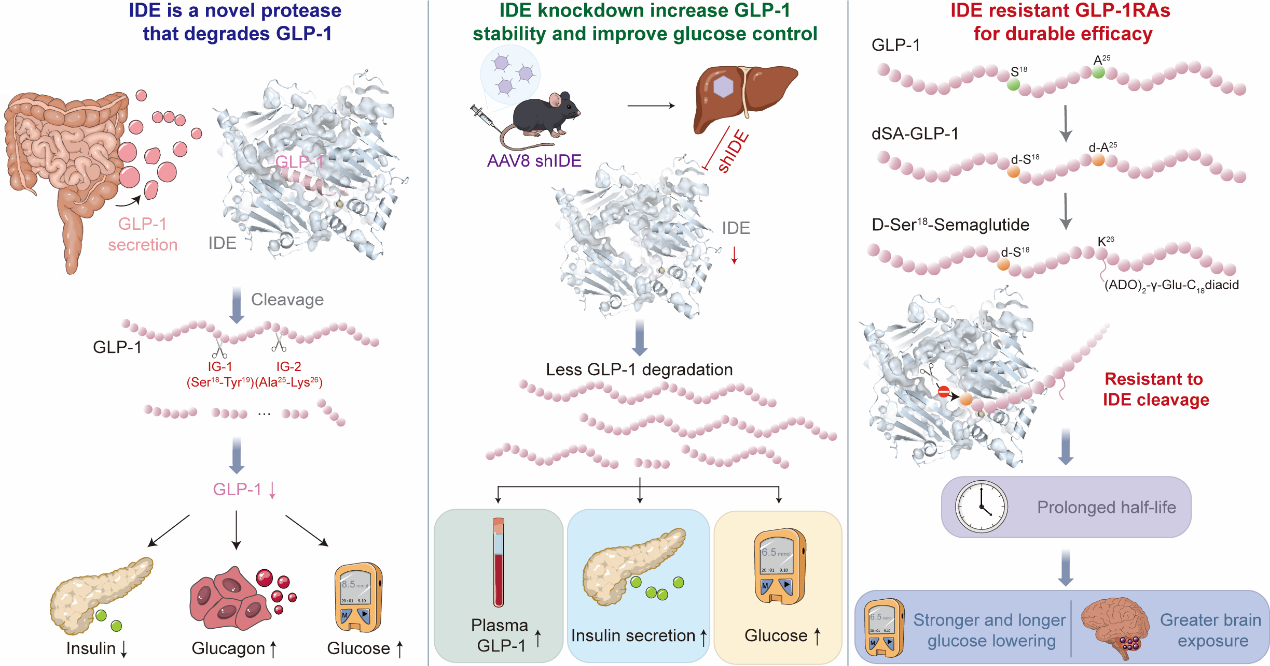
Fig 1. IDE-mediated GLP-1 degradation mechanism and the design strategy for IDE-resistant GLP-1 analogs.
Lu Zhang and Xinyi Liu are co-first authors of the study. Yaoyang Zhang and Bing Shan are corresponding authors. Yelin Chen and Junhao Hu from the Interdisciplinary Research Center on Biology and Chemistry, together with Xintian Hu and Christoph W. Turck from the Kunming Institute of Zoology, Chinese Academy of Sciences, also contributed to the work. The study was supported by the National Natural Science Foundation of China, the Chinese Academy of Sciences, and research programs of Shanghai Municipality.
Paper: “IDE-Mediated GLP-1 Degradation as the Basis for Designing Long-Acting and CNS-Stable GLP-1 Receptor Agonists,” Science Advances.
DOI: 10.1126/sciadv.aeh46
附件下载: